Tanzania Safari vs Kenya Safari: Which Is Better?
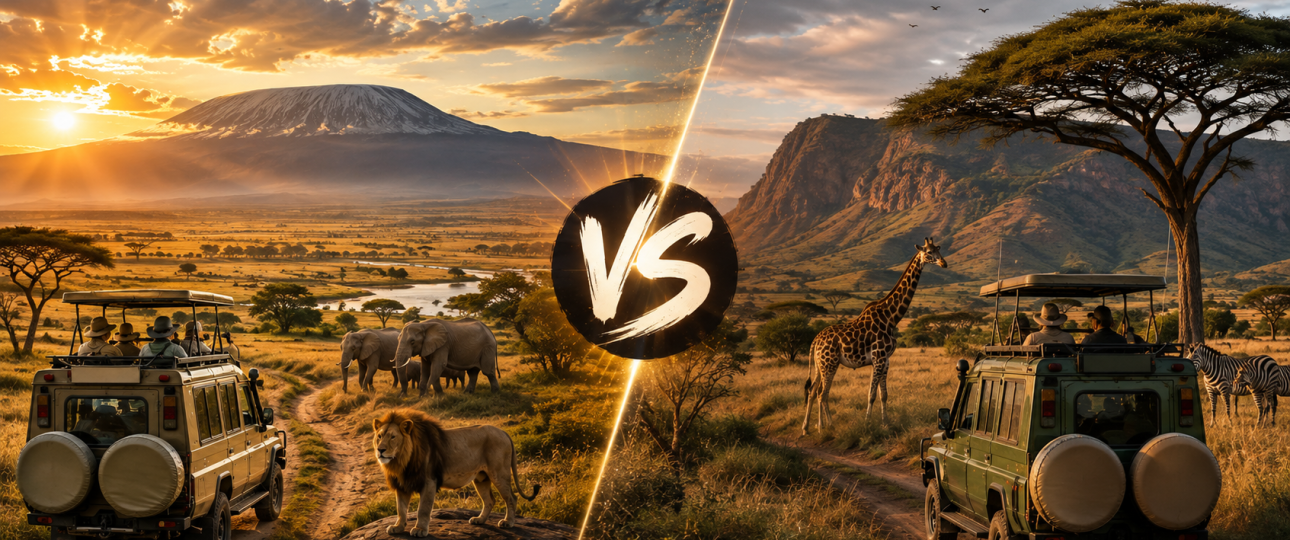
Tanzania and Kenya both deliver world-class safaris, but they suit different travellers. Tanzania offers larger parks, fewer vehicles per sighting, and the chance to combine the Serengeti with a Zanzibar beach stay. Kenya is generally more affordable, has shorter transfer times between parks, and gives easier access to the Masai Mara’s river crossings. Neither is objectively “better” — the right choice depends on your budget, the time of year you’re travelling, and whether you want wilderness immersion or convenience.
Key Facts Table
| Factor | Tanzania | Kenya |
|---|---|---|
| Main safari region | Northern Circuit (Serengeti, Ngorongoro, Tarangire, Lake Manyara) | Masai Mara, Amboseli, Lake Nakuru, Samburu |
| Typical daily cost (private) | Around $350 per person per day for a private safari | Around $300 per person per day for a private safari |
| 7-day trip cost range | Roughly $3,500 to $14,000 per person | Roughly $3,000 to $12,000 per person |
| Visa | E-visa $50 for UK/EU citizens; US citizens must buy the $100 multi-entry visa | eTA, roughly $30 for all entry types |
| Beach extension | Zanzibar (1–2 hours by flight) | Diani, Lamu (longer transfer) |
| Best for | Longer, immersive wilderness trips | First-timers, shorter or budget-conscious trips |
| Great Migration best months | Calving (Jan–Mar, Ndutu); river action shifts north Jun–Jul | River crossings July to October, with August and September the strongest months |
Introduction
Choosing between Tanzania and Kenya is one of the first big decisions on the way to booking a safari, and it’s not a straightforward one. Both countries sit inside the same broader ecosystem, share the wildebeest migration, and offer genuinely world-class game viewing. What separates them comes down to details: park size, crowd levels, cost structure, and how you want to spend your days.
This guide walks through the practical differences — wildlife, cost, timing, visas, and logistics — so you can match the destination to your trip rather than the other way around.
Tanzania Safari Overview
Tanzania’s safari circuit centres on the north: Serengeti National Park, Ngorongoro Crater and Conservation Area, Tarangire National Park, and Lake Manyara National Park. These parks are large and spread out, so many itineraries include internal flights between them rather than long road transfers. Optional extensions include Zanzibar, Mount Kilimanjaro, and the less-visited southern and western parks such as Nyerere and Ruaha, which are good options for travellers who have already done a first safari and want fewer vehicles at each sighting.
The trade-off for that space and scale is cost. Tanzania’s conservation fees are among the highest in Africa, and they show up directly in the price of the trip.
Kenya Safari Overview
Kenya’s classic circuit runs through the Masai Mara, Amboseli (with its Kilimanjaro backdrop), Lake Nakuru, and Samburu in the north. The parks sit closer together than Tanzania’s, so most Kenya safaris involve 2–4 hour game drives, compared to 4–6 hours in Tanzania, and road transfers between parks are shorter. That makes Kenya a practical choice for travellers with a week or less, or anyone who’d rather spend less time in transit and more time on game drives.
Kenya also has a stronger cultural-tourism layer near the parks, with more built-out options for visiting Maasai and Samburu communities close to where you’re staying.
Wildlife and the Great Migration
Both countries sit on the same migration route, so the “which has better wildlife” question really comes down to timing and terrain rather than one country having animals the other doesn’t.
Tanzania’s strengths: The Serengeti has the largest lion population and a wide variety of plains animals, and Ngorongoro Crater is a reliable spot for rhino and the rest of the Big Five in a compact area. The southern Serengeti and Ndutu area are also where the migration’s calving season plays out, typically from December into March, when hundreds of thousands of wildebeest give birth within a few weeks — a season Kenya doesn’t get.
Kenya’s strengths: The Masai Mara is the place to see the migration’s river crossings, and it’s easy to combine with a beach stay at Diani or Lamu. Kenya’s parks are also better suited to seeing large predators at close range in a shorter trip, since distances between prime viewing areas are smaller.
The river crossings, explained simply: The herds move northwest through the Serengeti and hit the Grumeti River first. They may wait on the riverbank for up to two weeks before crossing, with crocodiles waiting on the other side. The bigger crossing, at the Mara River, typically happens in July or August, and this is where most of the famous migration photography comes from. Wildebeest actually cross three rivers entering Kenya — the Sand River first, then the Talek, then the Mara — but only the Mara River delivers the dramatic leaps and crocodile encounters people picture. The peak window for crossings runs from July to October, with August and September producing the most consistent action. By late October, the herds begin moving back south toward the Serengeti.
Because the migration is weather-driven, exact dates shift year to year. If the Serengeti stays dry early, herds push into Kenya sooner; if the grass stays green longer in the south, the main crossing can be delayed into late August. No operator, however experienced, can guarantee a crossing on a specific day.
Cost Comparison
Cost is where the two destinations diverge most, and it’s worth understanding why rather than just comparing sticker prices.
Tanzania is typically 10–20% more expensive than a comparable Kenya safari, mainly because its national park fees are among the highest in Africa. As an example, Serengeti National Park charges $71 per adult per day plus VAT, and Ngorongoro Crater charges $60 per adult per day plus a $295 per-vehicle descent fee. On a standard 7-day Northern Circuit trip, park fees alone for two adults can reach $800–$1,200 before accommodation, transport, or guiding costs are added. Tanzania’s parks are also spread out, so many itineraries add domestic flights between them, and those flights typically run $300–$500 per person per segment — a real cost, but one that saves significant driving time.
Kenya’s cost advantage comes from shorter distances rather than lower park fees across the board. Kenya park fees generally run $60–$200 per day and mid-range safaris fall around $300–$400 per day, compared to $70–$100 in park fees and $400–$500 per day for mid-range in Tanzania.
At a trip level, the numbers look roughly like this:
| Trip length | Kenya | Tanzania |
|---|---|---|
| 7 days | $3,000–$12,000 per person | $3,500–$14,000 per person |
| Combined Kenya + Tanzania (16 days) | From around $14,696 per person | — |
Note the wide ranges — the gap between a budget group safari and a private fly-in luxury safari is much larger than the gap between the two countries. If cost is your main constraint, the level of accommodation and whether you fly or drive between parks will move your total more than the country choice will.
Best Time to Visit
For the Great Migration river crossings: July through October, with August and September the most reliable months, works best from the Kenyan side (Masai Mara). If you’d rather see the same crossings from the Tanzanian side of the border, the northern Serengeti in July and August is the equivalent window.
For calving season: December through March, based in the southern Serengeti and Ndutu area — Tanzania only.
For fewer crowds: The shoulder months (November and April–May, outside the long rains) offer good value and quieter parks in both countries, though some camps close during the heaviest rains in April and May.
For a first safari with limited time: Kenya’s shorter transfer times make it easier to see a lot in 5–6 days without long travel days eating into game drives.
Visas and Entry Requirements
Tanzania: Both US and UK citizens need a visa. UK and EU citizens pay $50 for a single-entry visa valid 90 days. US citizens must buy the multi-entry visa at $100, even for a single trip — this is a fixed reciprocity rule, not a choice. Applying for the e-visa online in advance is the more reliable route; processing typically takes 4–6 working days, so apply at least two weeks before departure. One Tanzania visa covers both the mainland and Zanzibar, so no separate paperwork is needed for a beach extension.
Kenya: Almost every non-Kenyan visitor now needs an Electronic Travel Authorization (eTA) rather than a visa, applied for entirely online before departure. The eTA costs around $30 for single entry, multiple entry, or transit, and typically clears in 24–72 hours. There’s no visa-on-arrival fallback in Kenya any more, so this has to be sorted before you fly, not at the airport.
Combining both countries: If you’re doing a Kenya-Tanzania combination trip, you’ll need both a Kenya ETA and a separate Tanzania visa — the East African Tourist Visa exists for some nationalities but doesn’t cover every combination, so check current eligibility for your passport before assuming it applies.
Health requirements for both countries: Malaria prophylaxis is strongly recommended, and yellow fever vaccination is required if you’re arriving from a country where yellow fever is present. Speak with a travel health clinic at least six weeks before departure.
Getting There and Getting Around
Tanzania’s main entry points are Kilimanjaro International Airport or Dar es Salaam, with flights from the US typically running $1,000–$1,400. Because the parks are spread across a large area, many itineraries use domestic bush flights rather than long game drives between stops. Tanzania’s currency is the Tanzanian Shilling, though US dollars are widely accepted for larger transactions, and major park gates take Visa or Mastercard only — cash isn’t accepted there.
Kenya’s main gateway is Nairobi, and its parks sit closer together, so road transfers of 2–4 hours are common rather than the norm being a flight. This is the biggest practical difference for anyone planning a shorter trip: Kenya lets you see more variety without as much time lost to travel.
Pros and Cons
Tanzania
Pros: larger, less crowded parks; the Ngorongoro Crater’s reliable Big Five sightings in a compact area; the option to add calving season; an easy Zanzibar beach extension on the same visa.
Cons: higher park fees; longer drives between parks unless you fly; the multi-entry visa requirement adds cost for US travellers.
Kenya
Pros: shorter transfers between parks; generally lower day rates; strong access to Masai Mara river crossings; simpler and cheaper entry process.
Cons: Masai Mara can get crowded with vehicles during peak crossing weeks; no equivalent to the Ndutu calving season; beach extensions (Diani, Lamu) involve a longer transfer than Zanzibar does from Tanzania’s parks.
Side-by-Side Comparison Table
| Tanzania | Kenya | |
|---|---|---|
| Park size | Larger, more spread out | More compact |
| Game drive length | 4–6 hours typical | 2–4 hours typical |
| Vehicle density at sightings | Generally lower | Can be higher near river crossings |
| Calving season | Yes (Dec–Mar, Ndutu) | No |
| River crossings | Yes, northern Serengeti | Yes, Masai Mara |
| Beach extension | Zanzibar, same visa | Diani/Lamu, longer transfer |
| Typical daily cost | ~$350/day private | ~$300/day private |
| Entry document | E-visa ($50–$100) | eTA (~$30) |
Expert Tips
- If seeing a river crossing is your top priority, base yourself on the Kenyan side in August or September — the odds are better there than trying to time a Serengeti-side crossing in the same window.
- Don’t try to see both the Great Migration crossings and calving season on one trip. They happen roughly six months apart, on opposite ends of the ecosystem.
- If your dates are flexible, shoulder season (June or November) in either country gets you good wildlife density with noticeably fewer vehicles at sightings.
- For a first-time visitor short on time, Kenya’s shorter transfers mean more actual game-viewing hours per day of travel.
- If Zanzibar is part of the plan, Tanzania is the simpler route logistically, since one visa covers both the safari and the beach days.
Common Mistakes
Assuming you can see a river crossing on any given day of your trip. Crossings are weather-dependent and can’t be scheduled. Build in at least 3–4 nights near the crossing points to improve your odds.
Applying for the wrong Tanzania visa type as a US citizen. US passport holders are required to buy the $100 multi-entry visa, not the $50 single-entry option — applying for the cheaper one gets rejected and you’ll pay the full amount again on arrival.
Leaving the Kenya eTA until the last minute. There’s no visa-on-arrival fallback any more, so an unapproved eTA can mean being denied boarding at your home airport.
Trying to do too much in too little time. Cramming both countries into a week usually means long travel days and rushed park visits rather than a genuinely immersive trip.
Underestimating park fees when budgeting Tanzania. The daily conservation fees for Serengeti and Ngorongoro add up fast for a family or group and are easy to overlook when comparing lodge rates alone.
Frequently Asked Questions
Is Tanzania or Kenya better for a first safari?
Kenya is often easier for a first trip because of shorter transfer times and lower entry costs, but Tanzania’s Ngorongoro Crater is also an excellent first-timer destination thanks to its concentrated wildlife in a small area.
Which is cheaper, Tanzania or Kenya?
Kenya is typically 10–20% cheaper than a comparable Tanzania safari, mainly due to lower park fees and shorter distances between parks.
Can I see the Great Migration in both countries?
Yes. The migration moves through both ecosystems throughout the year — the crossings are best seen from Kenya’s Masai Mara in July–October, while the calving season only happens in Tanzania.
How many days do I need for a Tanzania safari?
Most operators recommend 7–10 days to properly cover the Northern Circuit without rushing between parks.
How many days do I need for a Kenya safari?
5–7 days is usually enough to see the Masai Mara and one or two additional parks, thanks to shorter transfer times.
Do I need a visa for Tanzania?
Most travellers do, since Tanzania isn’t visa-free for most nationalities outside East Africa. UK and EU citizens pay $50; US citizens must buy the $100 multi-entry visa.
Do I need a visa for Kenya?
You need an eTA, not a traditional visa, and it costs around $30. It must be approved before you fly.
Is it safe to travel to Tanzania or Kenya on safari?
Both countries have well-established, professional safari industries. Standard travel precautions apply, along with malaria prevention and, where relevant, yellow fever vaccination.
Can I combine Tanzania and Kenya in one trip?
Yes. A combined itinerary linking the Masai Mara and Serengeti is popular, though it requires separate park fees and entry documents for each country, so budget extra time and cost for the border crossing.
What’s the best month for the Mara River crossing?
The Mara River crossing usually happens between August and September, though exact timing shifts with rainfall each year.
Does Tanzania or Kenya have more lions?
The Serengeti in Tanzania has the largest lion population of the two countries’ major parks.
Where can I add a beach holiday to my safari?
Tanzania pairs naturally with Zanzibar, a short flight from the northern parks and covered by the same visa. Kenya pairs with Diani or Lamu on the coast, though the transfer takes longer.
Is Ngorongoro Crater worth the extra cost?
For many travellers, yes — it’s one of the most reliable places in Africa to see the Big Five in a single day due to its compact size and high wildlife density.
What’s the weather like during safari season?
Both countries follow a similar pattern: dry season roughly June–October, short rains around November, and long rains typically March–May, though timing varies by year.
Do I need malaria medication for either country?
Malaria prophylaxis is strongly recommended for both Tanzania and Kenya. Speak with your doctor or a travel clinic before departure.
Which country has better luxury lodges?
Both have excellent luxury properties. Tanzania’s Northern Circuit and Kenya’s Masai Mara both offer high-end options, so this generally comes down to specific camps rather than country.
Is the Mara River crossing guaranteed if I visit in August?
No sighting in nature is guaranteed. August and September are the strongest months statistically, but crossing timing depends on rainfall and herd movement that year.
What currency should I bring?
Tanzania uses the Tanzanian Shilling, and Kenya uses the Kenyan Shilling, though US dollars are widely accepted in both for larger transactions.
Can I do a walking safari in either country?
Yes, both offer walking safaris in select conservation areas, usually with an armed ranger, though availability depends on the specific park and camp.
Should I book a group safari or private safari?
That depends on budget and preference for flexibility. Private safaris cost more per person but let you set your own pace and schedule around specific sightings.
Final Summary
Tanzania and Kenya aren’t competing so much as complementary halves of the same ecosystem. Tanzania suits travellers with more time, a bigger budget, and an interest in wilderness immersion or a Zanzibar add-on. Kenya suits travellers who want efficient access to the Masai Mara’s river crossings, shorter transfers, and generally lower costs. Many experienced safari-goers eventually do both — just not usually on the same trip.
Plan Your Safari with Lekobe Adventures
If you’re still weighing Tanzania against Kenya, a short conversation with someone who knows both regions can save weeks of research. Lekobe Adventures designs private and group itineraries across Tanzania’s Northern Circuit, with seamless Zanzibar extensions on the same visa.
Request a Custom Itinerary — tell us your travel dates and priorities, and we’ll build a route around them.
Talk to a Safari Expert — email info@lekobeadventures.com or call +255 676 68 1293.